Beyond the Shelf: Amazon Ads reshapes beauty launches
L'Oréal Professionnel's Amazon.ae campaign saw a 32x return from just one day of homepage takeover. It shows that the direction of beauty's launch budgets is more important than the number itself.
Let's travel back to 2020 and ask a beauty marketer where a product launch happens. Many would likely point to the usual choices: shelf placement, a magazine spread, and a paid social burst that ran intensely for two weeks before fading. Amazon would sit somewhere further down that list, serving more as a fulfillment channel, that place shoppers went once they'd already decided what they wanted and simply needed it delivered by Tuesday (thank you Amazon Prime for that; we - shoppers - still love you today and will do in the future as well!).
Yes, it might seem weird, but not so long ago, Amazon's role in a beauty launch came last. The beauty brands built their story elsewhere. Their main options were press, salons, paid social, and maybe a counter activation. Amazon was just where the stock rested after the campaign finished. The listing went live, some Sponsored Products spend switched on, and that was broadly that.
Now, it’s a whole different story. That sequencing has quietly inverted. For a growing number of beauty brands, Amazon is where the launch is designed from the start. Yes, you read it right. The media plan, creative, audience strategy, and storefront all centre on the platform. Everything else is organised around it. L'Oréal Professionnel's launch of Absolute Repair Molecular on Amazon.ae shows a clear shift.
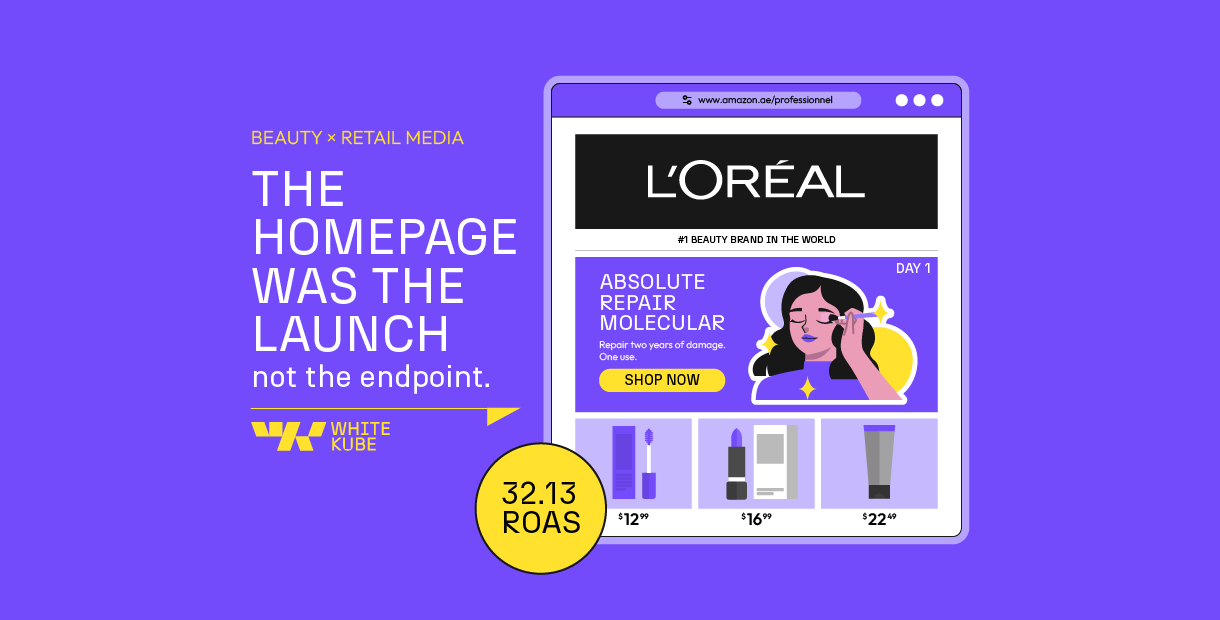
This is the number to remember from that campaign (well, that everyone in marketing does): 32.13. This was the return on ad spend generated on the day of a homepage takeover. It's a striking number, and also, on its own, close to meaningless.
What’s worth studying is how it was built. It’s a full-funnel campaign run entirely within one retailer's ad ecosystem. Amazon Ads were used not just for conversions but more like a broadcast network that takes payment.
A launch built as a funnel
Absolute Repair Molecular was launched on Amazon.ae based on an unusually aggressive claim for the haircare category: it can repair two years of hair damage in a single use (even if your martekin-ish language is not fully there, your beauty-ish one will fully get it). This is one of the boldest claims in haircare.
Claims that size doesn't sell itself from a product page. They need explaining, dramatising, and most importantly, believing. That's likely why L'Oréal Professionnel approached this launch like a media planner, not just a seller.
The groundwork was laid before a single ad went live. A brand lift study found that younger shoppers already showed strong intent to buy and consider the product. Reassuring?! Sure, but that’s not all.
The real insight came from older audiences. They weren’t engaged yet. So, we need a different, more persuasive approach for them in the campaign. Two audiences, two jobs, one funnel. Easy peasy! (or not so much!)
Reach came first. On launch day, the product dominated the Amazon.ae homepage. This prime spot ensured that almost everyone visiting the site saw the launch. That attention funnelled straight into a custom Brand Store, which did what a product listing never could: the science behind the formula, educational content, customer testimonials, all inside a branded environment with no competitor ads in sight.
Amazon DSP then carried the middle of the funnel. Video ads and display ads used a “time machine” concept. They highlighted the two years of damage claim on Amazon's inventory and many third-party sites and apps. Cold audiences were re-engaged with broad messaging; shoppers who'd already shown interest were kept warm with more specific offers.
By now you’re probably thinking: “Well, there's nothing exotic about the technique”, and you’re right. This is pure textbook programmatic discipline. The notable part of it is that it ran entirely inside a retailer's own ad stack, aimed at people that retailer already knew were haircare buyers.
The bottom of the funnel focused on sponsored ads: Sponsored Products and Sponsored Brands. These used video assets and clear, benefit-driven copy. They aimed for search results, the most competitive and high-intent space on the platform. And, around all of it, influencer partnerships pushed social traffic back towards Amazon.ae, feeding the same funnel from outside.
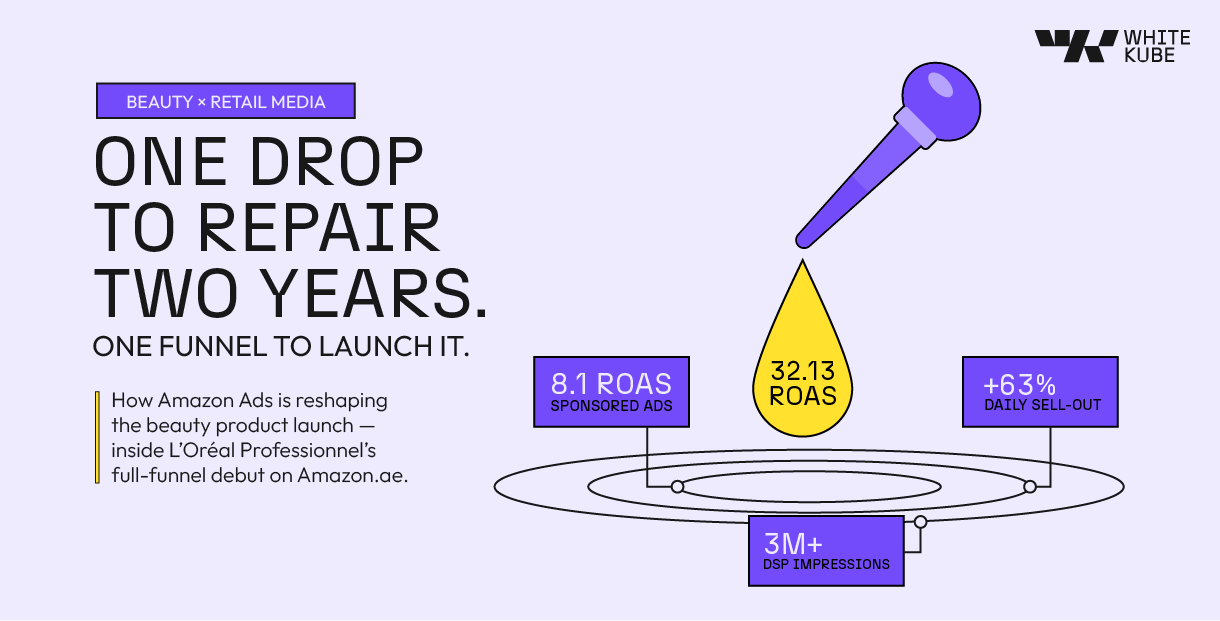
The results mapped cleanly onto that structure. The homepage takeover achieved a 32.13 ROAS on its run day. That’s four and a half times more than the previous day. It also boosted daily sell-out by 63% compared to the pre-campaign baseline. Amazon DSP delivered over three million impressions, with the purchase-focused portion returning 2.4 ROAS. Sponsored ads closed out the campaign at 8.1 ROAS.
Awareness, consideration, and conversion: three layers, three numbers. Each serves a unique purpose at a different cost. Read together, they describe a funnel working exactly as it should. Reading the 32x figure alone can be misleading. It suggests that one placement on a lucky day was responsible for everything.
Beauty took the lead

It's no accident that a case study like this comes out of beauty rather than, let’s say, kitchenware or any other category. Beauty shopping is different; it's all about discovery. People browse it like a magazine, not a shopping list. It's also very visual. A simple product photo and five bullet points won’t cut it. When it comes to beauty shopping, a serum or a bond-repair treatment is a story before it's a Stock Keeping Unit (SKU). Video, storytelling, and education are not luxuries here. They are the keys to making the product credible.
Beauty on Amazon is also, brutally, expensive. Amazon's Q1 2026 data shows that Beauty & Personal Care has an average cost-per-click of $1.39. This is the fifth-highest among the top fifteen categories. However, the category's ROAS only improved by 1.6% year-on-year.
Staying still on Amazon means falling behind. The cost of just showing up is rising.
Brands are paying more each quarter for clicks that hardly convert better than they did the year before. In an auction like that, competing on bids alone is a slow bleed. To compete before the auction, build demand early with DSP, video, and brand storytelling. This way, when a shopper types the search term, the sponsored ad closes a sale instead of starting a conversation. That is, in essence, the entire logic of the L'Oréal Professionnel campaign.
There's a wider industry figure worth noting here too. Beauty and personal care retail media spending rose by 53.2% year-on-year in the latest quarter, according to eMarketer data. This is the second-fastest growth rate among all measured categories, just behind health.
The same data by eMarketer mentions that Unilever flagged something similar in its Q4 earnings release, noting that reinvestment in “personal care and beauty portfolios is showing strong performance, and marketing reinvestment is shifting to premium brands”. Beauty isn't merely participating in the retail media shift; it's leading it.
That mix of a storytelling reward and an auction that penalises the confused explains why full-funnel thinking is now a must-have, not just an option.
A brand relying purely on Sponsored Products to push a new launch is competing on bid price alone, in a category where bids are already elevated. L'Oréal Professionnel took a different approach at first. They created demand using DSP and homepage placement. This meant that when sponsored ads appeared later, they had a more interested audience ready to convert.
What lies beneath the surface?
Zoom out from beauty and the pattern only gets bigger.
Retail media is one of the fastest-growing areas in advertising. It involves buying ads directly on retail platforms and using their first-party shopping data. eMarketer's latest US forecast shows retail media ad spend growing 18% year-on-year. It's now nearly 30% of all US digital ad spend, doubling its share from 2022, which was just 15%.
Most of that growth sits in two places: Amazon and Walmart, expected to absorb close to 89% of all new retail media investment in 2026, with Amazon alone holding an estimated 75 to 77% share of the US retail media market.
In other words, this isn’t just a story about "retail media" as a scattered chance across many networks. Most brands are now deciding to use Amazon, with Walmart Connect coming second, followed by a long tail of networks competing for scraps.
Amazon's own results support that reading. Advertising revenue reached about €15 billion (around $17.24 billion) in Q1 2026. This is a 24% increase from last year. The total for the trailing twelve months now exceeds €61 billion (approximately $70 billion). This puts Amazon Ads close to being the world's largest digital advertising business.
It’s also worth flagging for anyone building a deck off the back of any of this: these figures aren't perfectly comparable across research firms, because "retail media" gets defined differently depending on who's counting.
Global estimates for 2026 range from roughly €126 billion to €174 billion (about $145 to 200 billion) depending on who's counting and what they include. The sensible practice here is to stay with one source rather than blend them. The trend line, however, survives any definition: the money is moving fast, and mostly towards Amazon Ads.
Retail media, especially Amazon, has changed a lot. It used to be a last-minute option, but now it's a key channel. Brands now plan whole launches around it.
L'Oréal… well, it isn't the only one.
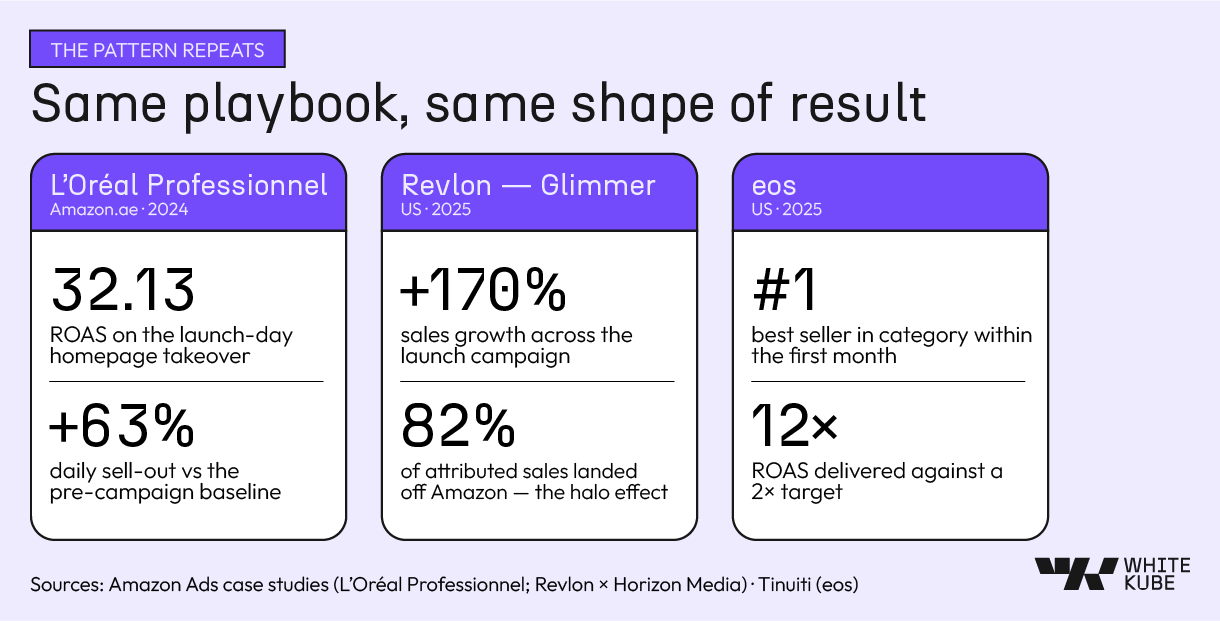
L'Oréal Professionnel's results aren't an outlier. Similar full-funnel launches, run by other beauty and personal care brands on Amazon, keep landing in comparable territory.
What makes L'Oréal Professionnel's launch worth building an argument on is that other beauty brands keep producing the same shape of result with the same playbook.
But there’s more.
In 2025, Revlon launched its Glimmer line with Horizon Media. They used Amazon Marketing Cloud to create custom audience segments. These included high-value new shoppers, cart abandoners, and keyword engagers. Then, they layered Prime Video, Amazon DSP, and sponsored ads on top of these segments. The campaign delivered 170% sales growth and a 46.85% year-on-year improvement in incremental ROI. And shoppers exposed to both Prime Video and search converted at 24 times the rate of unexposed audiences.
The most surprising number often goes unnoticed: 82% of the sales from the campaign came from retail channels besides Amazon. The advertising ran on Amazon; the sales turned up everywhere. That's a halo effect, not a closed loop. This idea offers a much smarter case for retail media spending than just looking at ROAS alone.
Another example: eos, with its 2025 body mist launch, run with Tinuiti and Skai. The brand became the top seller in its category just one month after launch. It achieved a 12x return on ad spend, exceeding its 2x target. Plus, it outperformed its launch-month forecast by 42%.
Different brand, different price, different agency, different product, but the same core idea: create real awareness and consideration before relying on sponsored ads to close the deal.
Big question: what about the money?!
This raises a big fat question (an obvious, and a fair one to ask): is any of this only for L'Oréal-sized budgets?
Parts of it aren't. Let's dig in.
A homepage takeover on Amazon.ae isn’t something you book yourself. It’s a premium buy that requires negotiation. Think of it as the Super Bowl spot for retail media. A big brand like L'Oréal Professionnel has a stronger chance of getting it than a small skincare label with a limited budget.
The wider picture is less exclusive, though. Amazon DSP, the tool doing most of the heavy lifting, carries no stated minimum spend on its self-service tier. The managed-service option offers more hands-on support from Amazon’s account team. It usually starts around €43,500 (about $50,000). While that’s a significant amount, it’s modest compared to the big deal mentioned earlier. And as for Sponsored Products, Sponsored Brands and Brand Stores, they’re open to any seller with Brand Registry, with all kinds of budgets.
Further down the funnel, the tools get more accessible still. A haircare brand teamed up with Blue Wheel. They added Sponsored Brands video to their current ad program. This change led to a 243% rise in impressions and a 384% boost in ad-attributed sales. They achieved this without a takeover or DSP, just by using self-serve formats better.
Here's a key insight for all marketers: Sponsored Brands campaigns that connect to a Brand Store perform 64% better on average. That is not about a L'Oréal's kind of budget, but setting up a Brand Store properly and pointing traffic at it. That's a configuration question, and a free one.
Simply put, it runs like this: the top of the funnel scales with money, the middle and bottom scale with competence.
What do we learn from this?
Strip the case study down to its core idea, and it isn't really about a homepage takeover, or the UAE, or even haircare. But the fact that L'Oréal Professionnel treated Amazon Ads as a complete media ecosystem for reach, engagement, conversion, measurement, and planned the launch inside it, the way brands used to do for planned launches around television.
Revlon and eos did the same thing. The results differ in scale, never in shape.
The real lesson is structural. All three brands succeeded by treating Amazon like a stack. They used homepage placements and DSP to reach customers. They relied on Brand Store for depth and sponsored ads for conversions. They then measured the whole thing as a funnel rather than taking each layer in comparison with others in isolation.
That's what "reshaping" actually means here. Amazon became somewhere a beauty launch could be conceived as a whole. Awareness came from video ads and display ads through Amazon DSP. Consideration deepened inside Brand Stores. Conversion was captured by Sponsored Products and Sponsored Brands. And the whole chain got measured against sell-out, not proxy metrics.
Beauty's retail media spend is growing 53% a year. And Amazon now absorbs three-quarters of that market. Brands still treating it as a shelf are now competing with those seeing and playing ahead, who show up with the full funnel already built.
Don’t get us wrong, the 32x will get quoted for years, but mostly out of context. But what should stand out is the strategy underneath.
Here's the data to recall:

RELATED
.png)


