Peak Shopping Season 2026: From Paid Media to Profitability
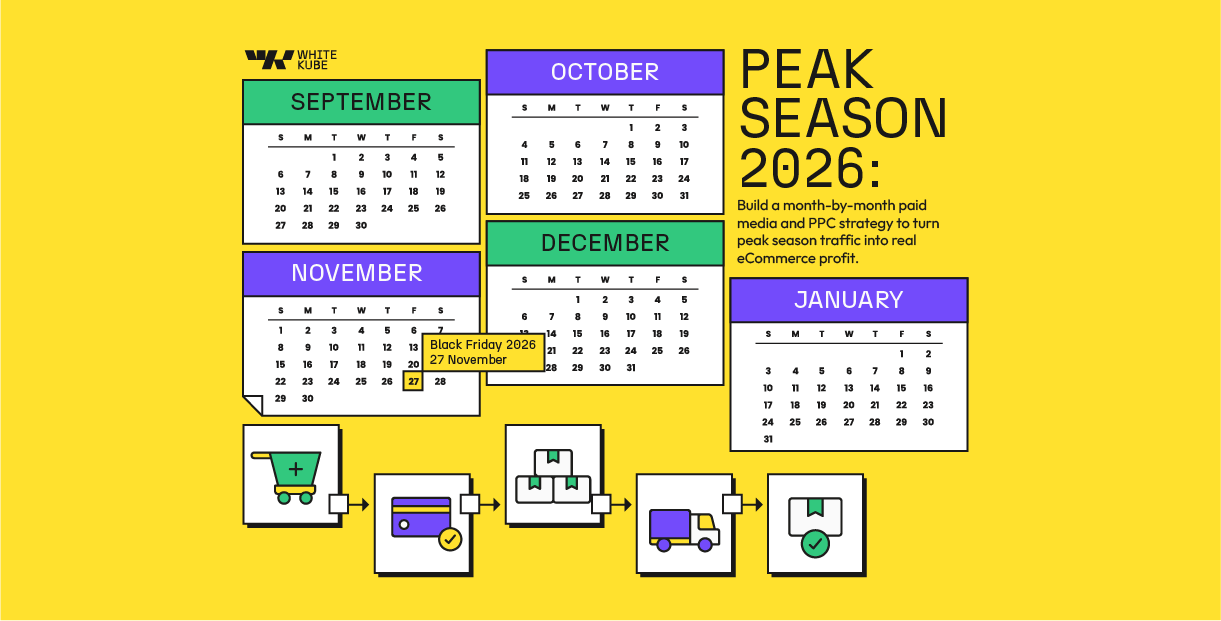
Mark your calendar: Black Friday lands on 27 November. Discover why the brands that succeed on Black Friday 2026 won’t just buy attention in November. Instead, they’ll earn it now, in September.
Peak season is back. Black Friday. Cyber Monday. A rush of ROAS targets and the moment Mariah Carey can sing again. Everyone is humming “All I Want for Christmas is You” in the background (or at least in their heads). Yes, you know the gist: every year, roughly around the second week of October, a peculiar madness descends on ecommerce teams. Budgets get doubled, and someone suggests a countdown timer. Sounds familiar?
Black Friday has been quietly making its way onto your marketing calendar. This happens between the last summer barbecue and the first Christmas ad (yes, they’re coming… as always - yay!!). In 2026, it lands on 27 November, with Cyber Monday on the 30th. If you're only just thinking about it now, you're roughly on schedule to be extremely stressed by mid-November.
But here are some uncomfortable truths about peak season:
1) Peak Season isn't a day; it’s not just about Black Friday and Cyber Monday; it's a Whole Season that happens to start with Black Friday, but it goes way beyond that;
2) Driving traffic has never been easier, and making money from it has never been harder.
Auctions get crowded. Costs go up, and discounts are everywhere. Your discount must stand out more than the next brand's, which is already louder than the one before. In the end, revenue goes up, but margin quietly slips out the back door.
A bit harsh, but that's what it is.
Here’s how to turn paid media into real profit, not just a flashy dashboard. This is especially important during the busiest and most competitive times of the ecommerce calendar.

Peak Season: It's a whole season
First things first: "Black Friday" hasn't meant a single day for years. Retailers now open the taps in late October and don't fully close them until the last Boxing Day parcel gets returned in January.
The calendar dates are set. Black Friday is on 27 November 2026, and Cyber Monday follows on 30 November. However, consumer behavior stopped sticking to these dates long ago. It’s like how your inbox doesn’t care about your annual PTO.
And the money involved keeps climbing, too. Online consumer spending in Europe hit €819 billion last year, say Ecommerce Europe and EuroCommerce. This year, growth is expected to reach another 7%. Salesforce estimates global Black Friday sales will hit around €68 billion in 2025. This is a 6% increase from last year. The entire November-to-December season is expected to reach about €1.1 trillion worldwide. So, yep, nobody is cancelling Christmas.
Online consumer spending in Europe hit €819 billion last year, as reported by Ecommerce Europe and EuroCommerce. This year, a growth of 7% is predicted. The shopping calendar is changing. An analysis by Admitad found that, in the UK, Cyber Monday orders now exceed Black Friday orders by about 9%. Savvy shoppers prefer the calmer, better deals a few days later instead of rushing in at the start.
Bigger spending doesn't mean an easier crowd, though. Just look underneath the headline and see how the shape has changed. The crowd is getting smaller even as the money gets bigger. In the UK, a key Black Friday market in Europe, PwC expects spending to reach €7.5 billion. This shows a small rise of 1.5%. However, only 46% of consumers plan to participate, down from 53% last year. Basket values rose to compensate, at roughly €305 per person. IMRG's peak coverage showed something similar: 35% of shoppers are now less interested in mega-sale events.
Read them together, and you see the key tension of peak season 2026: more money, from fewer people, over more days. Fewer shoppers are browsing over five weeks, each one worth more, instead of a 72-hour rush. The mob has become a jury.
The intent is still genuinely there when the day arrives. Global-e found that Black Friday conversion rates were 146% higher than early November's average. They stayed strong all the way through Cyber Monday. The order of play is changing. Admitad's analysis reveals that Cyber Monday orders in the UK now exceed Black Friday's by about 9%. Savvy shoppers are now skipping the rush on Black Friday for better deals a few days later. People are shopping to buy, not to browse.
Meanwhile, the cost of reaching them has gone the other way. Meta CPMs often run 20% to 50% above baseline in Q4. They can reach two to three times the yearly average during Black Friday week. Median Meta CPC peaked at about €1.13 in November before falling back to roughly €0.73 by January. Shopping CPCs across European ecommerce inflated over 13% year on year in Q4 2025.
Bigger spending doesn't mean an easier crowd, though. Eastside Co's research shows that only one-third of UK shoppers plan to shop on Black Friday this year. Also, fewer than one in ten plan to spend more than last year. Translation: the money's there, but you'll have to work harder for your share of it.
Higher costs, harder audience, longer window. Which is why the plan starts in September, not November.
As for the calendar per se, you might want to save this:

September to January: the peak season playbook

Here we go, navigating the peak season 2026 month-by-month:
September: decide what "good" actually means
Before any budget line shifts, define what success means. If you don’t, the platforms will set it for you, and their focus is on revenue.
Return on ad spend is the metric that quietly ruins peak. During a discount period, your revenue is deflated by 20 to 40% while your media is inflated by 20 to 50%. A 4x ROAS in June and a 4x ROAS on Cyber Monday describe wildly different commercial realities, and only one of them pays salaries.
Here are three swaps you need to make now:
1) Profit on ad spend: Same sum, gross profit on top instead of revenue. Send feed margin data to your platforms using custom labels. This way, the algorithms won't focus on your cheapest, easiest, or thinnest-margin Stock Keeping Units (SKUs).
2) Marketing efficiency ratio: Total revenue over total marketing spend. No attribution modelling, no arguments, no channel taking credit for the same order three times. It's the number you already trust, which makes it the number worth agreeing on before the season kicks off.
3) Contribution margin after shipping and returns: Free next-day delivery on orders over €35 comes with a €5 pick-pack-and-post fee. This isn’t a promotion. It’s a loss. Fashion return rates at peak season can be brutal. Consider this when measuring profit; otherwise, you're not getting an accurate picture.
And while you're at it, tier your catalogue: hero margin, acceptable margin, and stock you simply need gone. Paid media is for the first two. The third is what email is for, where the marginal cost of a send is roughly a rounding error.
October: buy the audience before the auction notices
This is the highest-leverage month of the entire peak season, and almost nobody treats it that way.
The idea is simple: every shopper you bring into an owned channel now—like email, SMS, retargeting, or your customer list- means you won’t have to bid triple in five weeks. IMRG, the UK's largest ecommerce association, shows this clearly. Late-October discounts led to about 30% lower CPCs compared to the same discounts later in the season.
Here’s what you should do:
1) Set up an early-access list properly: “Be the first to see our Black Friday deals” is a top way to draw customers in e-commerce. Early access is a key tactic retailers use during busy times. You are converting cheap October traffic into an asset that costs cents to activate in November. Offer an actual incentive, such as early entry, an extra 5% off or guaranteed stock, because shoppers can easily spot a bait-and-switch tactic.
2) Test creative now, scale it later: The worst time to find out your hero video isn't working is when impressions cost three times more. By the time November comes around, you should have two or three proven concepts up your sleeve, with a range of variations to choose from.
3) Feed the algorithms: Both Performance Max and Advantage+ Shopping require conversion volume and a clean signal to perform well. An account that has been trading consistently since September will reach its peak with momentum. An account that starts in the third week of November hits the peak learning phase. It spends the budget quickly as it figures out what a customer is.
4) Fix the product feed: Titles, Global Trade Item Numbers (GTINs), accurate product availability and custom labels for margin tiers. This may be the least glamorous job in PPC strategy, but it will deliver one of the most reliable returns all year. Nobody has ever been promoted for a tidy feed. However, plenty of people have quietly won promotion with one.
Early November: the phoney war
Deals now start in the first week of November and continue into December. This creates a genuine strategic decision: should you go early or hold your nerve?
Going early captures the planners and gets you into consideration sets before the noise peaks. Waiting protects your margin and allows you to reach the procrastinators (of which there are many). The conversion spike on the day itself shows that a lot of people still wait until the last minute.
For most brands, the logical approach is a phased one. This could involve offering early access to your list in week one; a limited category promotion in week two; and the full range available at the weekend. This spreads demand away from the most expensive auction days, provides three separate opportunities to email the same people and enables you to identify early trends before allocating your largest budget.
It also means planning around a global calendar rather than a domestic one. Diwali on 8 November and Singles' Day on 11 November both pull budgets into the auction well before Cyber Week opens, wherever you happen to sell.
Also, build an offer, rather than just a discount. Since a third of shoppers are bored of blanket price cuts, offer value instead in the form of bundles, gifts with purchase, extended returns until late January, loyalty multipliers and free personalisation.
Adobe's data revealed something counterintuitive: during the peak season, shoppers who would normally opt for the cheapest option start choosing the best they can afford because a sense of urgency combined with credible value changes their perspective. So showcase your premium products. Don't lead with the sale items.
The 96 hours: pacing, patience and creative rotation
When Cyber Week arrives, three things will try to hurt you.
1) Panic-induced budget increases: Doubling daily spending at 9 am on Black Friday makes campaigns restart learning at a bad time. Gradually increase budgets over the last two weeks. This way, the account will be ready and scaled up by Black Friday.
2) Creative fatigue: You're targeting a smaller audience far more frequently than usual. The ad that performed well on Thursday will be exhausted by Sunday. Plan a schedule with a hero concept and regular updates based on different angles, such as price, urgency, gifting, social proof and category. Nobody produces good creative work at 11 pm on Black Friday.
3) Brand search cannibalisation: When intent is this high, your branded terms, retargeting and any long-window channel will all claim credit for purchases that would have happened anyway. This is precisely how brands end up spending their budget on maximising sales rather than creating demand. Run at least one geo holdout: switch a channel off in one region and keep it live in another to compare results. It may feel reckless, but it's the most valuable lesson you'll learn all season.
And here's a bonus tip for 2026: AI-assisted shopping. Adobe saw a 693.4% jump in traffic to retail sites from generative AI tools during the 2025 holiday season. Meanwhile, Salesforce linked around €225 billion of global holiday revenue to AI and agent-driven sales. The direction of travel is clear. Structured data, honest specifications, genuine reviews and accurate stock and delivery information are becoming an essential part of the distribution strategy rather than a technical afterthought.
December: the month everyone forgets to monetise
Once Cyber Monday is over, most accounts decline. However, this is a mistake because December is the time for full-price gifting. In fact, Salesforce found that global sales in the final two weeks of December increased by 12% year on year, outpacing the first half of the season.
The dynamics of shopping change: shoppers are buying for someone else, so price sensitivity drops and delivery certainty becomes the main consideration. This brings us to the single most overlooked conversion lever during the peak season. Parcel Perform data showed that, during the peak season, carriers were averaging 1.54-day delivery times, while many retailers were still promising five days or more at checkout — playing it safe with their own metrics and losing sales in the process. Retailers who were honest about delivery times of two to three days converted better.
You are paying peak CPMs to send traffic to a checkout that is discouraging your customers from buying. Address this issue and then promote it: cut-off dates are a legitimate paid media message, and creating a sense of urgency without offering a discount is the most cost-effective approach.
January: where peak profitability is actually decided
Peak season is when customers are acquired at the highest cost of the year. If they only make one purchase, you've effectively paid a high price for revenue and called it growth.
Before November, create the second-purchase journey. This should include:
- Post-purchase flows
- A reason to return in January
- Timing for product replenishment
- A welcome series that does more than just say "thanks for your order"
Your high-value Black Friday customers are looking for options. Media costs drop in January, just when your competitors are quiet. This is the cheapest retention window of the year, yet almost nobody uses it deliberately.
It's also worth noting that Christmas isn't the end of the year everywhere. Three Kings' Day is on 6 January. It remains the main gifting deadline in Spain and much of Latin America. This creates a full-price selling window while the rest of the market has stopped bidding.

Ad budgets: where is the money actually going?
The big question is: where is everyone spending?
Search and social make up the biggest part of most ecommerce budgets. However, retail media (like ads on Amazon, retailer websites, and TikTok Shop) is growing quickly. WARC Media reports that global retail media spending will top €172 billion in 2026. This amount is too significant for anyone focused on peak season to overlook.
Retail media is key. It places your product in front of consumers ready to buy. This happens before they enter the research phase or think "maybe later." For UK ecommerce brands, this now includes Amazon Ads and retailer-owned media like Tesco, Boots, and ASOS. They also continue to spend on Google and Meta.
The old guard hasn't gone soft either, and neither has the new guard. Google's Performance Max and Meta's Advantage+ are absorbing more automated budget than ever. This is efficient until you realise that nobody's actually watching what the algorithm is doing with your money.
The PPC handbook: from clicks to contribution margin
This is where theory meets your actual account. Smec's European ecommerce tracker shows that the median Google Ads CPC for Search is about €0.43. Also, Shopping CPCs rose by about 14% year-on-year last quarter, during the peak season. A solid PPC strategy doesn't just react when costs surge; it anticipates it. Here's what distinguishes the brands that make a profit during peak season from those that merely survive it:
- Segment before you scale: Break your campaigns into categories based on intent: branded, generic, competitor, and remarketing. This way, you can tell which performs better instead of relying on a confusing average.
- Set ROAS floors, besides targets: A "good" ROAS in March may not be good later. For example, Shopping CPCs rose sharply in Q4 last year, impacting performance. Build your floor around contribution margin, not last year's figures.
- Give Smart Bidding a head start: Algorithms need time and data to learn, so don't start from scratch on 20 November. Ensure that the conversion data is clean, and allow campaigns to run on a real, modest budget for a period of two to three weeks beforehand.
- Don’t let the landing page be the weak link: If your page is slow, not mobile-friendly, or hides the offer, you waste traffic. Also, asking visitors to register before seeing the price can drive them away.
- Protect your brand terms: Competitors will bid on your brand during peak season. It's cheap to defend and expensive to lose, so it's better to defend than to lose.
The hidden pitfalls that turn revenue into regret
Every peak season, brands inadvertently reduce their profit margin in the same ways.
The discount spiral is the classic example. One brand gives 20% off, another offers 25%. By the third week of November, many are practically giving away stock. They call it a promotion, but it makes their biggest sales period their least profitable month.
Vanity ROAS highlights a big number but ignores key costs. It overlooks shipping fees, payment charges, returns, and discounts. A campaign could report an impressive 6x ROAS but still lose you money once the real costs are taken into account.
Stockouts are a form of self-sabotage in themselves. Paying to drive traffic to a product page that says 'out of stock' is just paying to annoy your best customers.
There’s also the attribution blind spot. iOS privacy changes and multi-device shopping make platform reporting unreliable. Trust your own first-party data more than any platform's dashboard. Each platform is, after all, grading its own homework.
Profitability is the only scoreboard that matters
Revenue is a vanity metric that is dressed up in business-casual attire to make it look more appealing. Profitability is how we measure peak season success.
First, know your numbers:
- Contribution margin per order.
- Blended customer acquisition cost across all channels, not just the cheap ones.
- Post-sale effects that many peak-season plans miss.
Research by Bain & Company found that a 5% lift can increase profit by 25 to 95%, depending on the industry, a bigger boost than most Google Ads accounts. A healthy lifetime-value-to-acquisition-cost ratio is usually 3:1. This means if you spend one pound, you should earn three back over the entire relationship, not just from the first order.
Peak season is great at attracting one-off, deal-driven shoppers who disappear the moment the discount ends. Brands that genuinely profit from Black Friday and Cyber Monday treat the sale as the start of a relationship rather than the end of a transaction. Post-purchase email and SMS campaigns quietly turn discount hunters into repeat customers.

Reminder: your countdown to Peak Season is on
If you're reading this in September, congratulations, you're in the sweet spot.
Here’s what the countdown should look like:
- September: Thoroughly audit last year's campaigns; don't just take a quick look. Clean up your product feed, fix your tracking and start testing creative content that you will want to scale up later.
- October: Set up your segmented campaign structure. Load your promotional calendar. Then, begin warming up Smart Bidding with a small budget.
- Early November: Increase spending gradually rather than suddenly on the 27^(th). One agency found that UK web traffic rose nearly 20% and conversions soared over 45% the week before Black Friday. This shows that warm, ready audiences convert better than cold ones. Also, a sudden spike can confuse automated bidding and drive up costs.
- Peak week: Monitor daily pacing, stock levels and CPCs, as they can all change quickly enough to blow a budget by Wednesday lunchtime.
- December onwards: Don't switch everything off the second Cyber Monday ends. Retarget and follow up to prove that the peak-season customer was worth acquiring in the first place.
Win big this peak season
Peak 2026 will involve more money, fewer participants and a longer duration, as well as higher media costs. The brands that come out on top won't necessarily be the ones who bid the hardest during the final week of November. They defined their profit margin in September. They acquired their audience in October. In early November, they presented their offer. They stayed focused over the weekend. They effectively monetized December and retained their customers in January.
The bidding war will always take your money in exchange for the attention it has priced at a premium. The key is to secure the majority of that attention months earlier at a discount while others were still debating the banner.
Bottom line: Peak Season 2026 will reward brands that treat paid media as a source of profit rather than just a means of increasing traffic. The dates aren't changing, and 27 and 30 November are already marked in red by all your competitors. So, the real question is how you will use the ten weeks or so between now and then.
Build your strategy around margin, not last year's ROAS figures. Remember that the goal was never simply to survive Black Friday, but to come out of it with a clear profit.
Here's the key data to keep in mind:

RELATED